

UAE VAT compliance 2026 looks different from anything businesses have dealt with before — and most business owners do not know what has changed.
The Federal Tax Authority has issued a major public clarification — VATP046 — that explains two rounds of VAT law changes: one that took effect in October 2024 and another in January 2026. Together they change how businesses handle imports, tax invoices, VAT refunds, and supplier relationships.
If you run a UAE business and you are registered for VAT, these changes apply to you. Some of them come with hard deadlines. Miss them and you lose money — permanently.
This guide explains every change in plain language, tells you exactly what it means for your business, and gives you a checklist to follow.
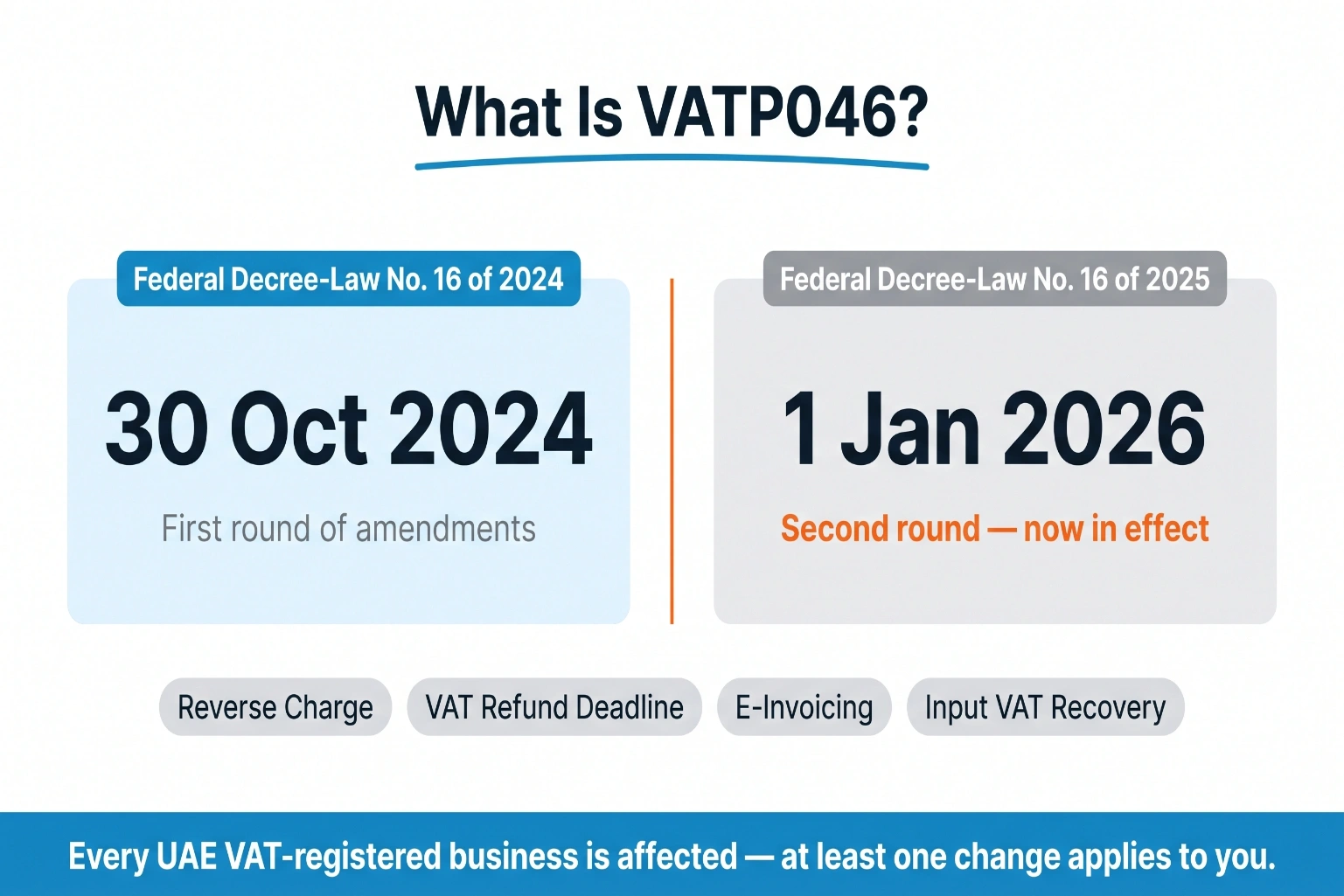
VATP046 is an official document from the Federal Tax Authority. It explains the changes made to the UAE VAT law through two amendments:
Federal Decree-Law No. 16 of 2024 — active from 30 October 2024.
Federal Decree-Law No. 16 of 2025 — active from 1 January 2026.
Think of VATP046 as the FTA’s official explanation of what the new rules mean and how you must follow them. It is not optional reading — if you are VAT-registered in the UAE, these rules already apply to you.
The changes cover six areas: who counts as a UAE resident for VAT purposes, how to handle imports, VAT refund time limits, new invoicing rules, the FTA’s new power to deny your input VAT claim, and limitation period updates. Each one is explained below in plain terms.
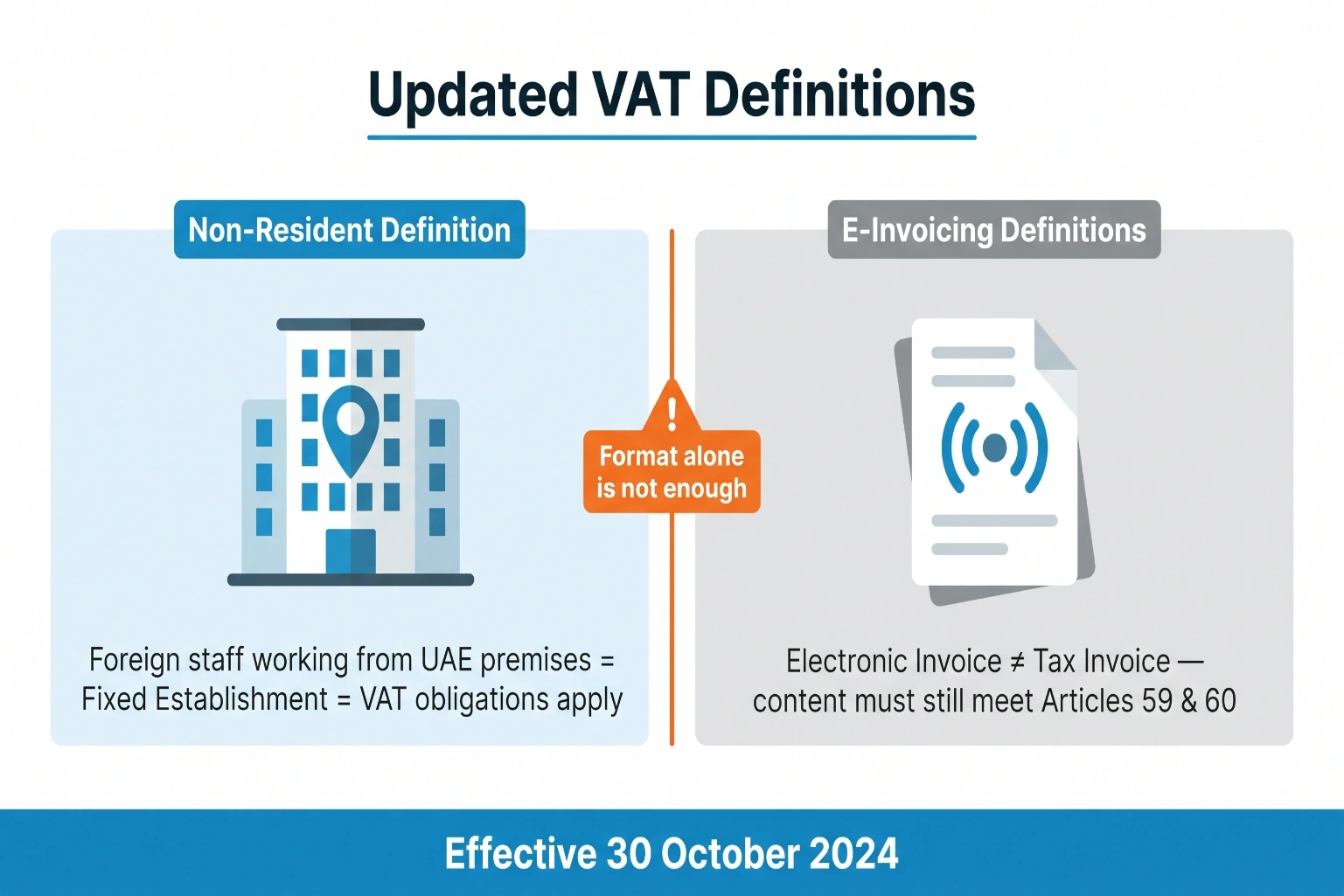
Two important definitions were updated in October 2024.
Before this change, a foreign company could sometimes avoid being treated as a UAE business — even if its staff were working from a UAE client’s office every day. That loophole is now closed.
Under the new rule, a foreign company is treated as having a presence in the UAE — and therefore as a UAE resident for VAT purposes — if its employees regularly work from a place in the UAE, even if the company does not own that place. The devices they use (laptops, phones) in the UAE count too.
What this means for you: If you use a foreign service provider whose staff regularly work from your office in the UAE, that provider may now be classified as a UAE resident. This changes who is responsible for VAT on their services. You may no longer need to account for VAT on their behalf under the reverse charge mechanism — they may need to register and charge VAT directly. Get this checked by a tax professional if it applies to your business.
Three new terms were added to the VAT law to prepare for the UAE’s e-invoicing system:
Electronic Invoicing System — the official digital system for sending and receiving invoices
Electronic Invoice — a digital invoice in a specific structured format
Electronic Credit Note — a digital credit note in the same format
One important point: an electronic invoice is not automatically a valid tax invoice. To be a valid tax invoice, it must still meet all the existing VAT requirements for content and format. The digital format alone is not enough.
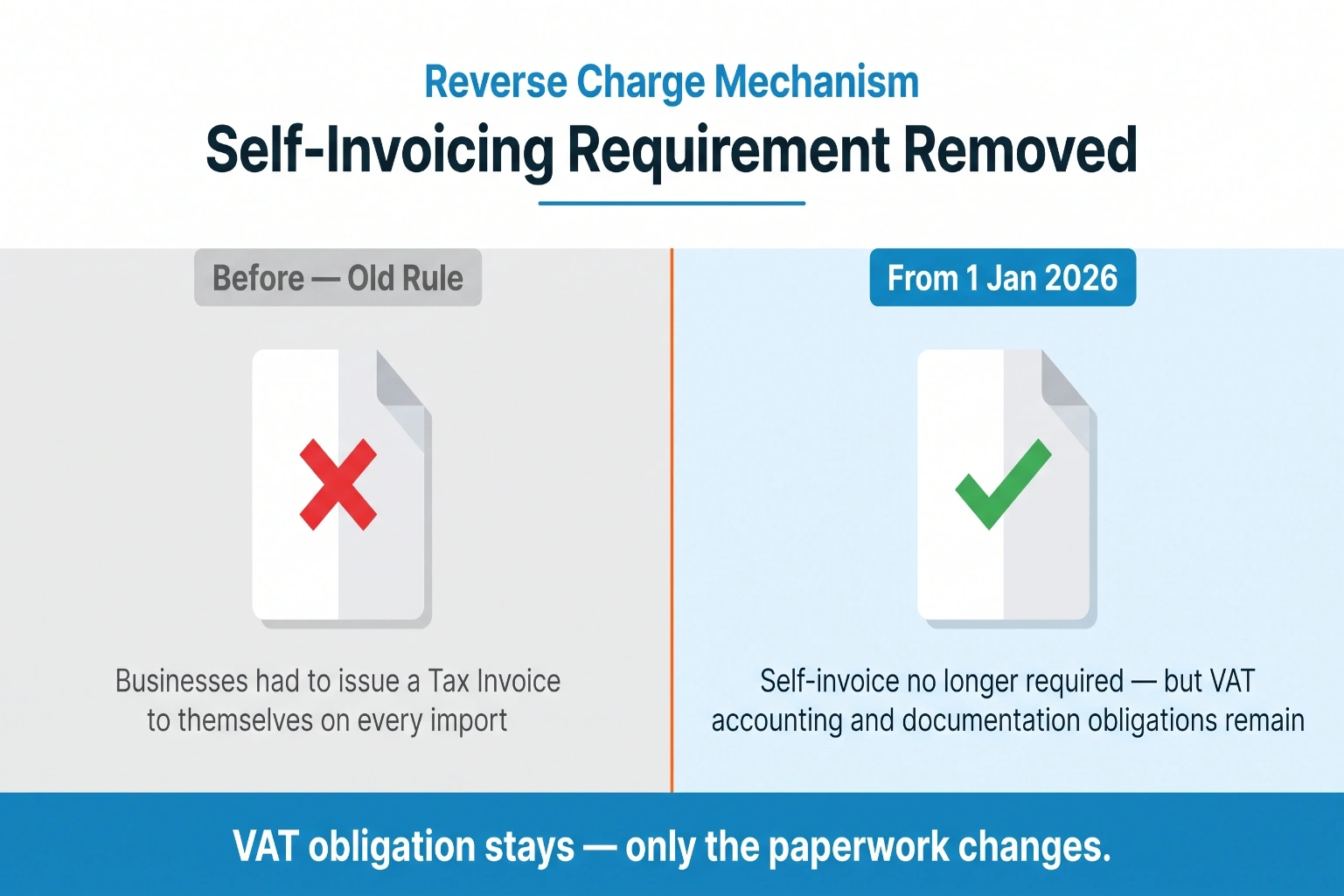
This is good news for most businesses. From 1 January 2026, you no longer need to issue a self-invoice when you import goods or services.
Under the old rules, when a UAE VAT-registered business imported certain goods or services, it had to create an invoice addressed to itself. This was called a self-invoice or self-billed invoice. It was used to record both the VAT owed on the import and the input VAT being claimed back. It created a lot of paperwork — especially for businesses that import regularly.
The self-invoicing requirement is gone for imports made on or after 1 January 2026. You no longer need to create that document.
Removing the self-invoice does not remove your VAT obligation. You still need to:
For imports made before 1 January 2026, the old rules still apply. Keep those self-invoices on file.
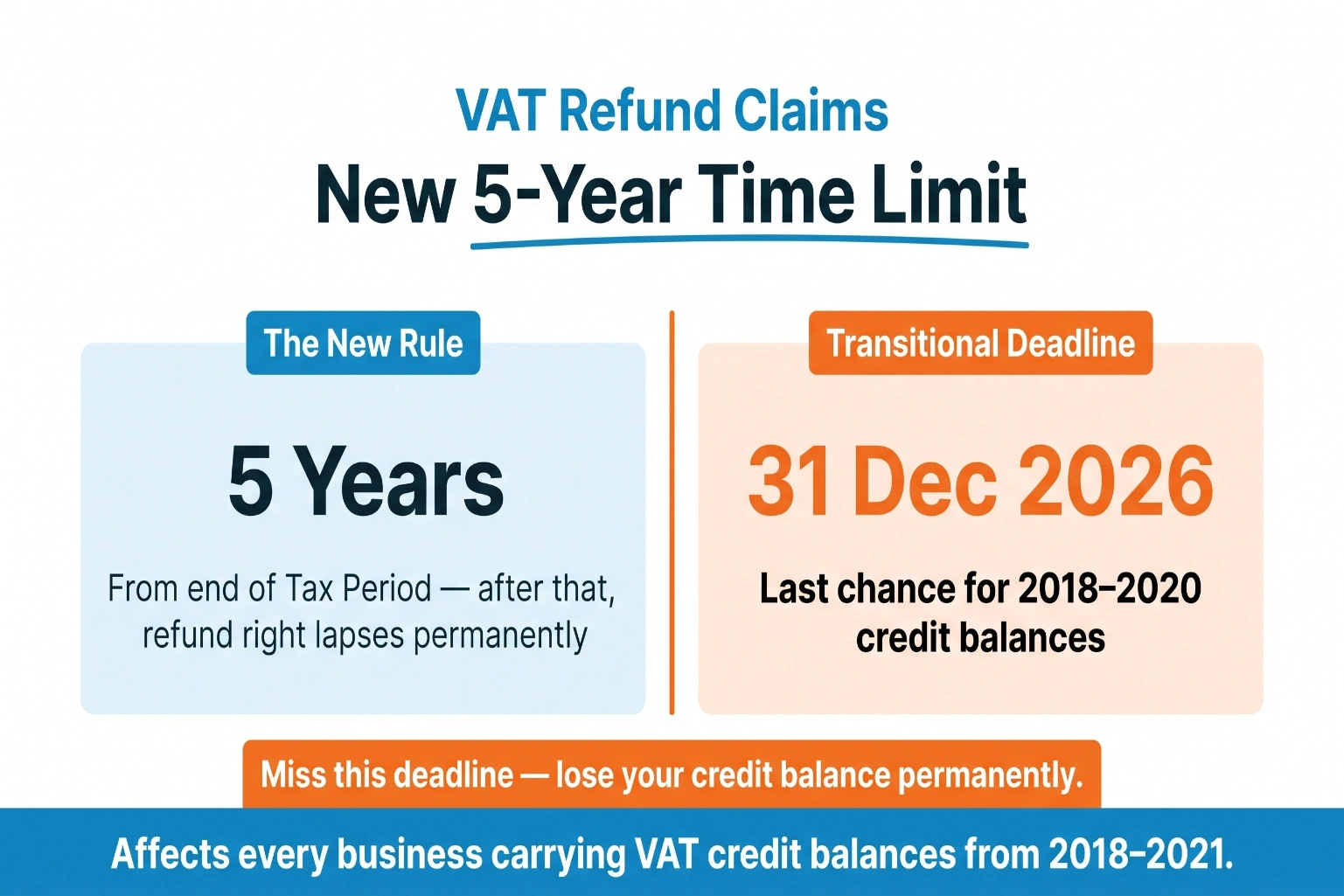
This is the change with the biggest immediate financial risk — and the one most businesses are not aware of.
If your VAT returns show that the FTA owes you money — meaning your input VAT is higher than your output VAT and you have a credit balance — you now have exactly five years to claim that money back. After five years, the right to claim it expires permanently. The FTA will not remind you. The money does not carry forward indefinitely anymore.
The five-year countdown starts from the end of the tax period in which the credit arose.
Say your VAT return for January 2026 showed a credit balance of AED 50,000. You have until January 2031 to either use that credit to pay future VAT bills or submit a formal refund application. If you do nothing by January 2031, you lose that AED 50,000 permanently.
Here is the part that urgently affects many businesses. If you have been carrying VAT credit balances since 2018, 2019, or 2020 — which many businesses have — some of those credits may already be at or near the five-year limit.
The FTA has allowed a one-time grace window: any old credit balance that would have expired before the new rule came in can still be claimed — but you must submit the refund application by 31 December 2026. After that date, those credits are gone.
If your business has any historic VAT credit balances, check them immediately and take action before the end of 2026.
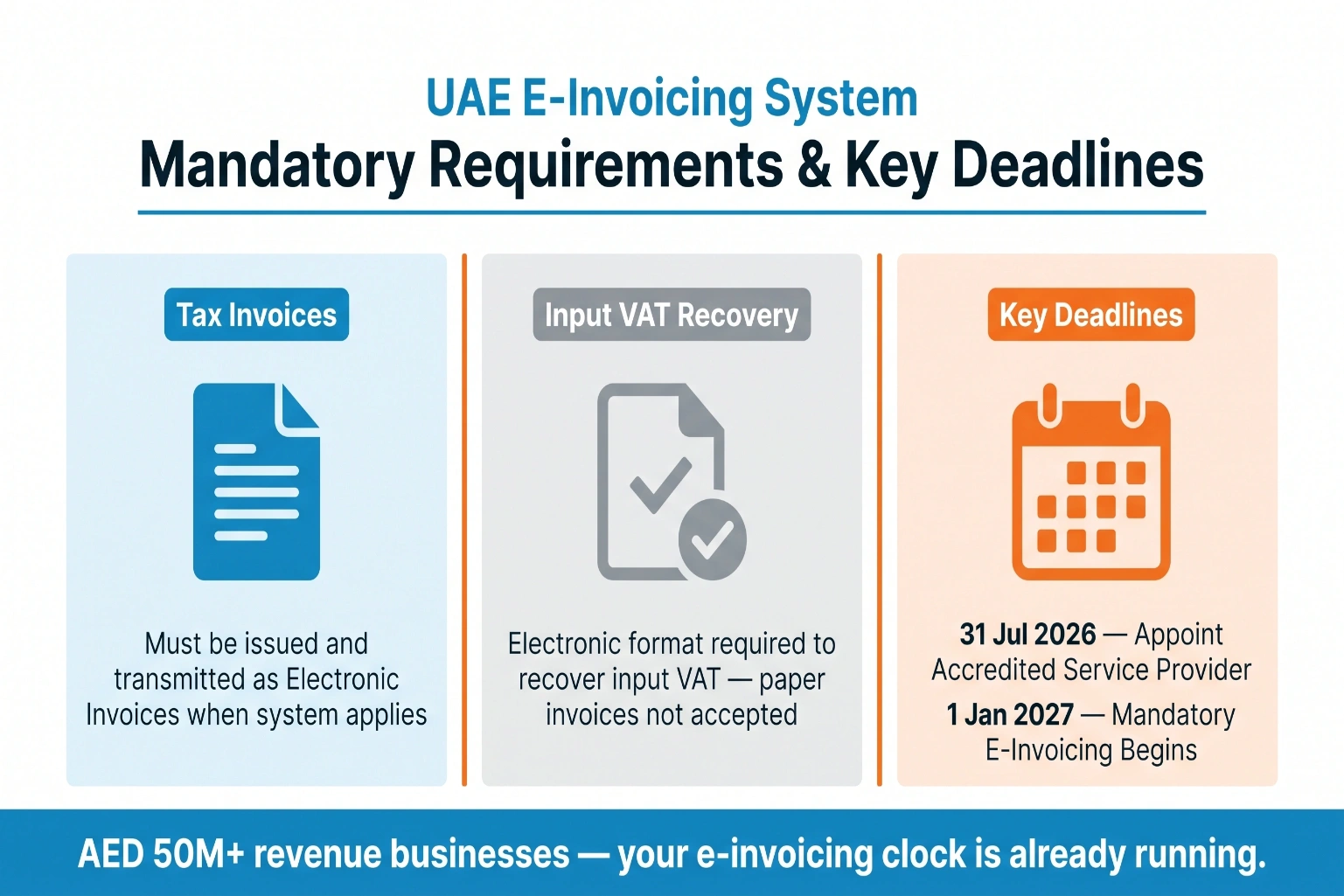
The UAE is rolling out a mandatory electronic invoicing system. VATP046 explains how this connects to VAT compliance.
Instead of sending PDF invoices or paper invoices, businesses in scope will be required to issue invoices through an approved electronic system — similar to what Saudi Arabia has already implemented. The invoice data goes through an FTA-approved platform and is transmitted digitally.
Three updates were made to the VAT law to support this:
First, businesses subject to the e-invoicing system must issue and send Tax Invoices as Electronic Invoices through the system. Second, they must issue Tax Credit Notes as Electronic Credit Notes the same way. Third, to recover input VAT, you must retain the invoice in electronic format if it was required to be issued electronically. A paper copy or a PDF of an electronic invoice is not sufficient for input VAT recovery if the e-invoicing system applies to you.
Missing the deadline to issue an invoice — or issuing it in the wrong format once e-invoicing is mandatory for you — results in an administrative penalty. Under Cabinet Decision No. 106 of 2025, the penalties include AED 5,000 per month for failing to implement the system, AED 100 per invoice not sent correctly, and AED 1,000 per day for failing to notify the FTA of a system failure.
If your annual revenue exceeds AED 50 million, you must appoint an FTA-Accredited Service Provider by 31 July 2026 and be ready for mandatory e-invoicing from 1 January 2027. If your revenue is below AED 50 million, a later phase applies — but start preparing your systems now.
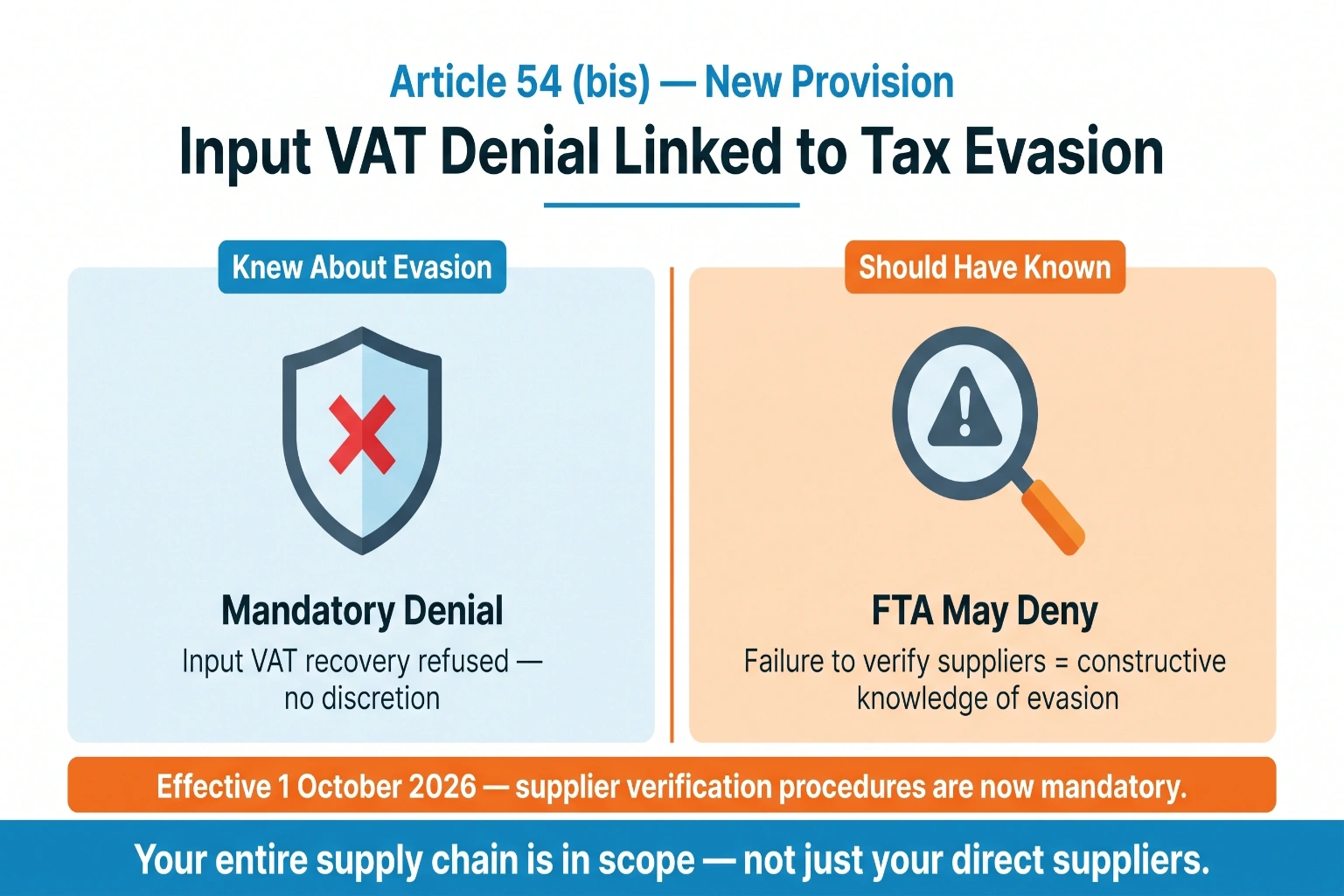
This is the most important new rule in the entire amendment. It changes something fundamental about how input VAT recovery works in the UAE.
Under the old system, if you had a valid tax invoice and paid for a supply, you could recover the input VAT — even if your supplier turned out to be involved in tax evasion. As long as your paperwork was correct, your VAT claim was safe.
That is no longer the case. Under the new Article 54 (bis), the FTA can deny your input VAT claim if it finds that the supply you received was part of a supply chain connected to tax evasion — and you either knew about it or should have known about it.
There are two levels:
The most important part: “should have known”
The law says you are automatically considered to have “should have known” if you did not verify your supplier before claiming input VAT. In other words, if you receive an invoice, claim the VAT, and later it turns out the supplier was part of a fraudulent scheme — and you did not check them properly — you lose the VAT. Even if you had no idea.
This is why supplier due diligence is now a legal requirement, not just good practice. The FTA has issued a separate decision (FTA Decision No. 13 of 2026, effective 1 October 2026) that sets out exactly what checks you must carry out on each supplier. These include verifying their identity, their place of business, their risk profile, and their bank account for high-value transactions.
The supply chain covered by this rule is broad. It is not just your direct supplier — it includes any person involved anywhere in the chain of supplies linked to the evasion.
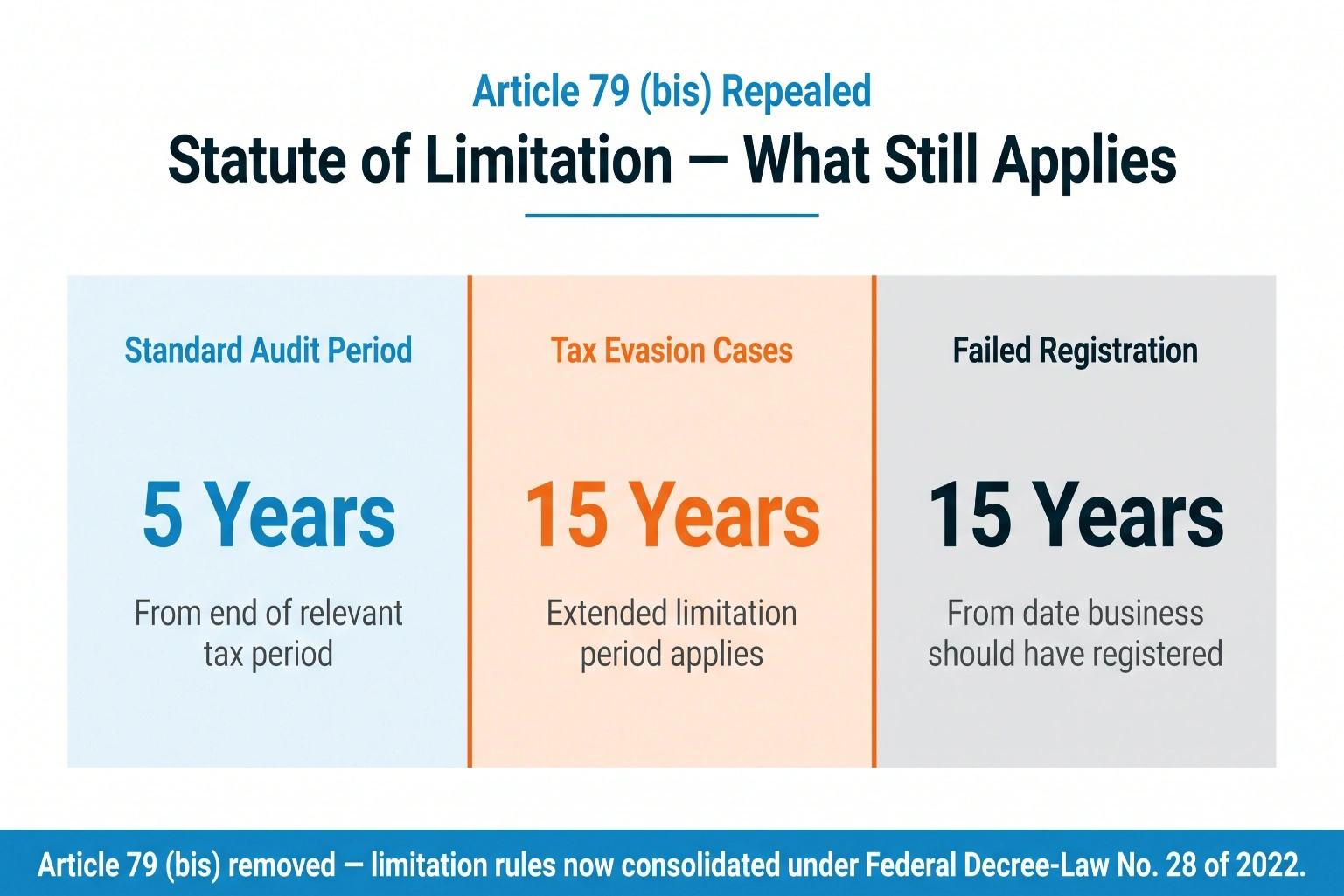
This one is simpler. A specific article about limitation periods for VAT — Article 79 (bis) — has been removed from the VAT law. This does not mean there are no time limits anymore. It means the limitation rules have been consolidated into a single law covering all UAE taxes — Federal Decree-Law No. 28 of 2022 on Tax Procedures.
The practical limits remain the same:
Nothing changes practically — it is simply tidier legislation. But the fifteen-year window in evasion cases is a reminder of how seriously the FTA treats non-compliance.
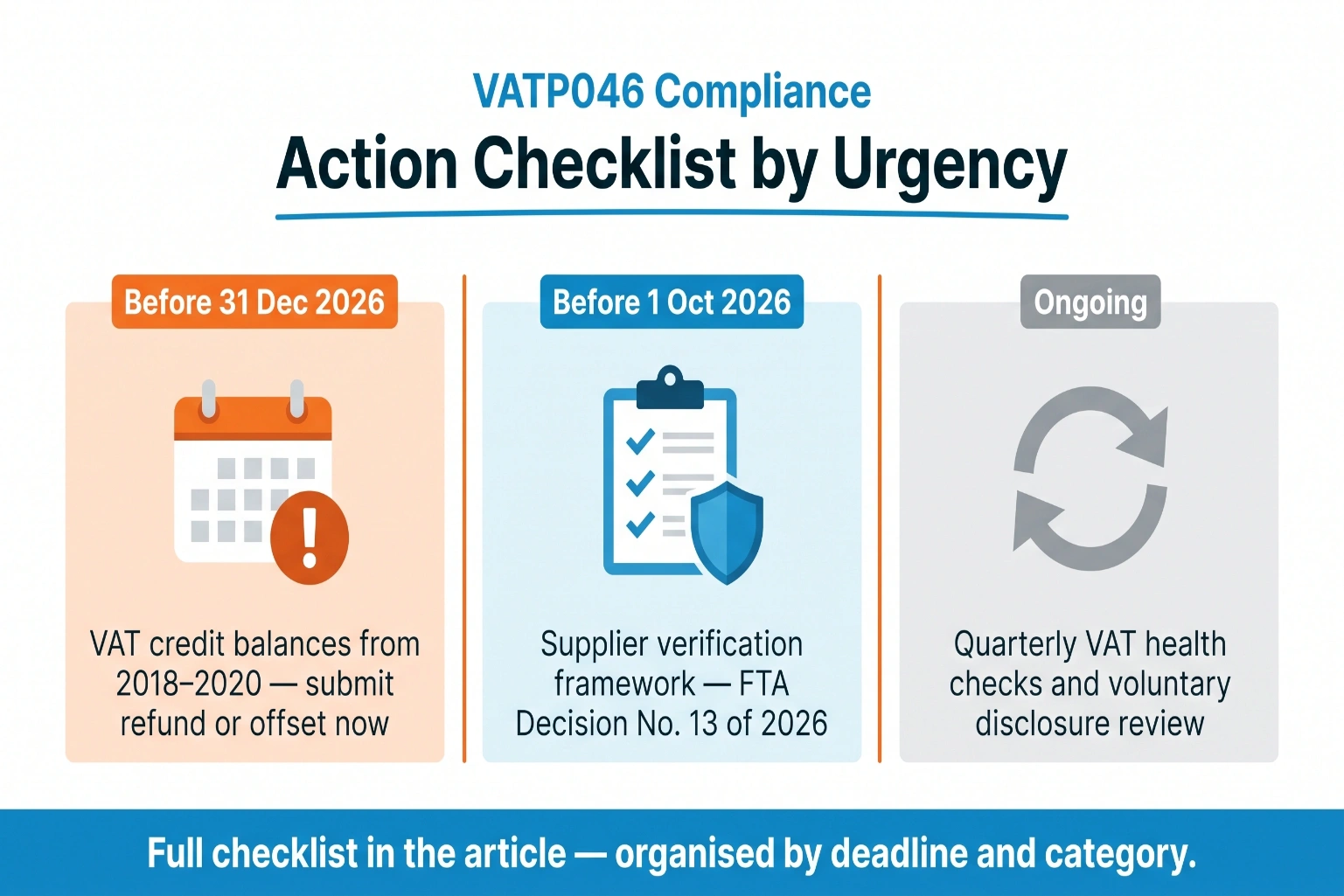
Here is your complete action list, ordered by urgency.

At ThinkBizPro, we help UAE businesses stay ahead of VAT changes — not catch up after a penalty arrives.
For these amendments specifically, we can help you:
Like this article? Share with your friends!
Your trusted partner for business setup, accounting, and corporate solutions across the UAE.
Copyright by thinkbizpro.com. All rights reserved.